
In the Beginning: Graphic Touchscreen Point of Sale
Prologue
The beginnings of ViewTouch and the history of the birth of colorgraphic touchscreen `PoS' (Point Of Sale) over the past four decades is an interesting story that has never before been told. In it lies the story of the birth of Point of Sale software and systems. I'll be publishing some of these details into writing here for the first time. This story-in-progress will not be just the history of a company which wrote some history but it will also be an unfolding vision from a company which continues to make history.
The world is blanketed by restaurants using touchscreen point of sale software, and to the untrained observer there is little difference between the software that runs on any particular touchscreen from any other. This is true in several important ways and I want to explain not only why that is true but I want to also explain my role in this process over the past four decades.
The short answer is that these systems are all the same because they were all copied from the same system, and that the system was that good, and there were no patents to violate, no royalties to pay. The moral of the story is that if you build it, and it's good, and you travel all over the world, showing it to people everywhere, letting them copy it as they understand it, then they will do that. If it's a software paradigm that is good enough, easy enough, and useful enough, then it will overwhelm the world. And it has done that.
In the Beginning:
In 1977, ten full years before I began doing business as ViewTouch, I began the process of developing `PoS' software for the restaurants which I had built and operated in Norfolk, Virginia and in Syracuse, New York. I had purchased one of the first Apple ][ computers in 1977 and began writing software to create a longer lasting and more useful result (i.e., a historical context) from the end-of-day transaction summaries that the first electronic cash registers produced on a paper tape at 'Z Out'.
It was in 1979 that the failure of the very expensive motherboard in that DTS electronic cash register led me to replace it with the Apple ][. I had only to extend the programming I had already done to analyse transactions to allow the Apple ][ to also record the transactions and print the relevant details of each transaction in the kitchen to create the world's first restaurant PoS software.
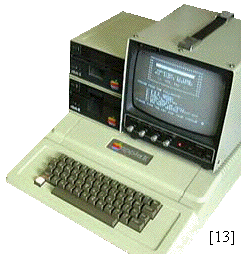
At Gene Mosher's Old Canal Cafe at 316 South Clinton Street, Syracuse, New York, we would enter customers' orders with and Apple II computer using order entry (Point of Sale) software I had written. and accept payment at the front door, print the orders in the kitchen, and often deliver their lunchtime sandwiches to their tables even as they were sitting down. It was a tremendous experience as a restauranteur to be able to allow customers with a thirty minute lunch break a full twenty minutes to enjoy a sandwich, soup or salad and a fresh-squeezed lemonade or a Marble Farms milkshake made without syrup. In 1979 the sidewalks were rolled up at 5pm but today that area of downtown, Armory Square, has undergone a very successful downtown revitalization.
My PoS system was the first time that anyone actually recorded sales and communicated sales information in real time to a restaurant kitchen using a 'home computer'. It was nearly three years later that the IBM PC would find its way to the market and the term 'personal computer' would arrive. The concept had been proven in 1979, however, and it was inevitable that the cash register would soon be 'uninvented', a fate that it certainly deserved. Even then, in the early 1980's, it was already apparent that a touchscreen would be a better input method than a QWERTY keyboard, but touchscreen technology and colorgraphic monitors were very primitive and very expensive. That would change in 1986.
In late 1983 I sold my restaurants, moved to Oregon and began doing business there in early 1984, first as Order Entry Programming, then briefly in 1986 as VideoTouch, and finally in January of 1987 as ViewTouch. In 1986, I hired Nick Colley to do the programming in the C language to complement and bring to life the color bitmapped touchscreen GUI that I was developing. The result was the world's first colorgraphic touchscreen point of sale computer. We used the revolutionary Atari ST 520, the only computer up to the job at the time. More about that later...
Across five decades I have been fascinated with and transformed by my chosen role of 'writing the book' of PoS software design. Since I first began transforming personal computers into dedicated PoS computers I have been driven by an unbroken, expanding vision extending into the unforeseeable future. Although I am intensely private individual I tell this story publicly because it is an important one which no one else could tell to those of you who would understand the events which contributed to the building of the foundation of the worldwide phenomenon of colorgraphic touchscreen PoS software.
--- Gene Mosher
PoStscript: I have often been asked if I am Jewish and no, I am not. My surname (i.e.,family name), Mosher, is not a Jewish surname. Mosher is one of several 400-year-old Americanized spellings of the 16th century Moger family of Cucklington, Somersetshire, England, of whom I am a descendant. Nicholas Moger/Mosher, a son of French Huguenots, and other Huguenots immigrated from England to Tiverton, Rhode Island in 1638.
Chapter 1
In
October of 1977 I purchased one of the very first Apple ][
computers (Apple Two) from Bob Person at The Computer Store in
Lynnhaven Mall in Virginia Beach. The Apple ][ had first been
introduced at the West Coast Computer Faire in April of 1977 and had been generally
available since about August. I had to take out a bank loan
for $1,800 to buy it. By the time it was equipped for a satisfying
home computer experience it would represent a $5,000 investment.
In 1977 $5000 was enough money to buy a new car or make a
substantial down payment on a home.
![Apple][ RAM](a2ram.jpg) One of the
buying decisions was whether to keep the 4k dynamic RAM chips that were in it or to remove them, throw
them away, and buy the new 16k dynamic RAM chips. It was a
$600 decision which required 24 socketed 16k RAM chips, making mine a 48k
computer. I would use my 300 baud tape cassette player as an
external storage device. All that for a mere $1,795 + $600.
Wow. Serial # 753. Now I had to get the thing to
handle more than just whole numbers between -32768 and 32768. The
AppleSoft firmware card solved that early in 1978. Now I had
to get a 40-column, 25 line black and white monitor.
$300. A few months later Steve Wozniak's brilliantly designed floppy disk drive
($595) arrived. It was as much of an engineering
breakthrough as the computer itself was. Overnight, IBM's own
vastly inferior floppy drive technology became obsolete. The
best thing about floppy drives was that we could stop using audio tape
recorders for program and data storage. Man, you could HATE
that most primitive kind of storage. Actually, it was my
one-year-old son, Corey,
who forced me to upgrade my system with floppies the day he destroyed
my collection of cassettes by pulling all the magnetized mylar out of several of
them.
One of the
buying decisions was whether to keep the 4k dynamic RAM chips that were in it or to remove them, throw
them away, and buy the new 16k dynamic RAM chips. It was a
$600 decision which required 24 socketed 16k RAM chips, making mine a 48k
computer. I would use my 300 baud tape cassette player as an
external storage device. All that for a mere $1,795 + $600.
Wow. Serial # 753. Now I had to get the thing to
handle more than just whole numbers between -32768 and 32768. The
AppleSoft firmware card solved that early in 1978. Now I had
to get a 40-column, 25 line black and white monitor.
$300. A few months later Steve Wozniak's brilliantly designed floppy disk drive
($595) arrived. It was as much of an engineering
breakthrough as the computer itself was. Overnight, IBM's own
vastly inferior floppy drive technology became obsolete. The
best thing about floppy drives was that we could stop using audio tape
recorders for program and data storage. Man, you could HATE
that most primitive kind of storage. Actually, it was my
one-year-old son, Corey,
who forced me to upgrade my system with floppies the day he destroyed
my collection of cassettes by pulling all the magnetized mylar out of several of
them.
In January of 1980 the Apple SilenType thermal printer ($595) became available. I purchased one from a computer store on Erie Boulevard in Syracuse and constructed a 65-foot serial cable which could connect my Apple computer at the Old Canal Cafe's front door to the kitchen area. $65 - and it was a pretty good deal, I thought. And the 5 1/4" floppy disks, $10 each. Building a Point of Sale system I was, in the 1970's. I was going to make sense of the information that my DTS-400 electronic cash register (which I had purchased from Jack O'Donnell in Norfolk) was tabulating, give it an historical perspective.
At this point I closed my Virginia Beach and Norfolk restaurants and moved them to Syracuse, New York. Soon after opening day in 1980 the DTS-400 died. In search of a way to repair the motherboards I visited Dumac Cash Registers. I met Howie Macarthy who told me that his father was going to replace the motherboard in the DTS-400 for only $500. I wasn't going to pour good money after bad. I would turn my Apple computer into more than just a device into which I entered information from the cash register tape. I would turn it into a device to take the food orders - to record the transactions.
I
decided simply to write an Interpreted Basic program to extend what the Apple is doing to record
the sale on the front end. I could keep the $500, save hand
entering sales totals every day, and take the orders at the front door
in enough detail, and print the details in the kitchen and really speed
up service. yet.
 OK, I would
do that. Voila, the world's first PoS software/solution on a computer, Gene Mosher's Old Canal
Cafe, 316 S. Clinton ST., Syracuse, NY, 1980. I stayed up
till nearly dawn for several months to write the world's first PoS
system running on a home (personal) computer. I wrote software for order entry, remote kitchen printing, sales
analysis, inventory cost accounting, time clock and labor cost accounting.
OK, I would
do that. Voila, the world's first PoS software/solution on a computer, Gene Mosher's Old Canal
Cafe, 316 S. Clinton ST., Syracuse, NY, 1980. I stayed up
till nearly dawn for several months to write the world's first PoS
system running on a home (personal) computer. I wrote software for order entry, remote kitchen printing, sales
analysis, inventory cost accounting, time clock and labor cost accounting.
Chapter 2
By 1983 I had decided to exit the restaurant business and embark on a career of writing a better PoS system. I had already experimented with an infrared touchscreen which I purchased from a company in Washington, D.C.. I moved to Eugene, Oregon and spent the next three years looking for a better computer and cultivating my network of interested parties.
In the early 1980's
there was a breakthrough CPU, the Motorola 68000, being used in workstations. Not an 8-bit CPU like the ones
used in personal computers (PCs), it was a 16-bit CPU and was designed to
provide workstation users with advanced dedicated computing power.
There were important differences between workstations
and PCs. Workstations were designed to provide more computing
power, a greater variety of functions and were designed to make big advantages
out of their built-in networking. Bitmapped screens and graphics
displays were a standard workstation feature, but could not be found in
any personal computer. A workstation sold for about $20,000
compared to a $5,000 to $7,000 unit
cost for a PC. While a PC system was entirely self-
contained, workstations were usually attached to a network in order to share
devices like printers and file servers. For a few years this kind of
power and integration would not be available to the public.
In 1985 that would change. 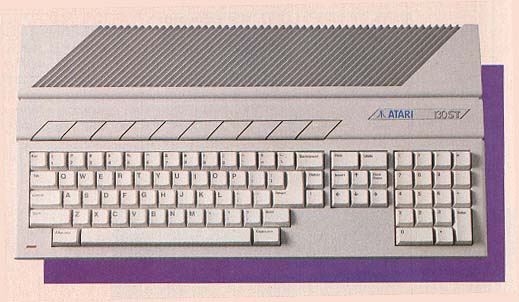 It
was in 1985 that a revolutionary new computer would arrive in the
market. It was designed by Shiraz Shivji for Jack
Tramiel was introduced into the market. This, the Atari ST
520, was the first consumer computer with the power and integration of a
workstation. It had a single chip graphics subsystem, a SCSI
interface, a bit-mapped color desktop GUI for file management and for application launching.
This was the GEM interface from Digital Research. And the computer was
incredibly affordable. It was a breakthrough that still is
largely unappreciated. Those of us who did appreciate it have
always known better.
It
was in 1985 that a revolutionary new computer would arrive in the
market. It was designed by Shiraz Shivji for Jack
Tramiel was introduced into the market. This, the Atari ST
520, was the first consumer computer with the power and integration of a
workstation. It had a single chip graphics subsystem, a SCSI
interface, a bit-mapped color desktop GUI for file management and for application launching.
This was the GEM interface from Digital Research. And the computer was
incredibly affordable. It was a breakthrough that still is
largely unappreciated. Those of us who did appreciate it have
always known better.
In January of 1986 I received a phone call from Ed Ramsey, a restaurant/bar operator in Springfield, Oregon, which led to a contract to provide a computer-based PoS system. We would use the Atari ST. In March I had hired Nick Colley and we began work on the first generation of graphic touchscreen PoS software, making the most of the advantages of the Atari ST. By September we were ready to install the world's first colorgraphic touchscreen PoS workstation in the restaurant, in Springfield, Oregon, right down the street from Bart Simpson, of whom you may have heard.
 I
was just getting married again in November of '86, to Barbara Hooker of Crystal Lake, Illinois.
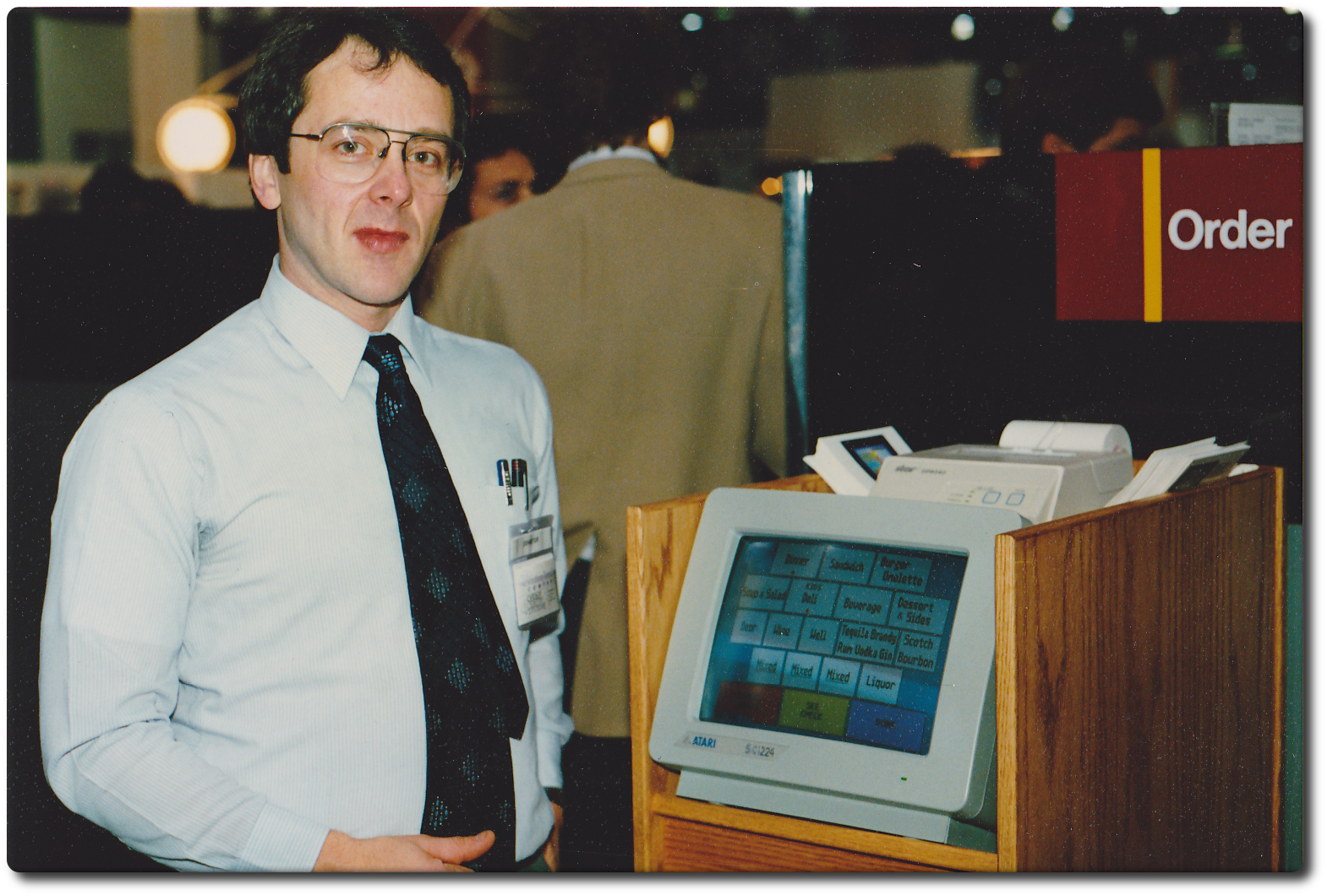
Barb and I spent our honeymoon doing the ViewTouch PoS demo for five days at the Atari booth
Fall Comdex '86, introducing thousands of people to the World's first graphic point of
sale software solution. Among the many visitors was John Oram, of
Sacramento, California and Walter Dreesman, of Niewegein, The
Netherlands; they are just two of several people who were there
at the and who remain among my friends these several decades
later.
I
was just getting married again in November of '86, to Barbara Hooker of Crystal Lake, Illinois.
Barb and I spent our honeymoon doing the ViewTouch PoS demo for five days at the Atari booth
Fall Comdex '86, introducing thousands of people to the World's first graphic point of
sale software solution. Among the many visitors was John Oram, of
Sacramento, California and Walter Dreesman, of Niewegein, The
Netherlands; they are just two of several people who were there
at the and who remain among my friends these several decades
later.
The printer at the top of the specially built wooden cabinet which Paul
Armstrong, of Eugene, Oregon had built was a Star Micronics
DP-8340. The designer of that printer, Bernie Larsen, introduced himself to me at the show and
we remained in touch from that time onward. At the show I had
decided to change the name of the software from VideoTouch to ViewTouch. I am the owner of the ViewTouch
trademark, registered at the US Patent and Trademark Office, with
first use documented on January 4, 1987.
 Here's
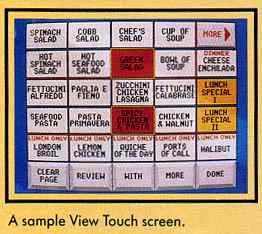
a page from Atari's
Start magazine, Vol. 2 No. 6, Spring '88 which includes a screen
shot which I provided to them. It's one of the pages from the
restaurant menu of the very first graphic touchscreen software system
ever installed anywhere in the world, in the Summer of 1986.
It ran on an Atari ST 520 and loaded from 3 1/2" Floppy Drives.
This system was first shown at Fall Comdex, 1986. It's an image drawn
by me with the NeoChrome
paint program that was part of the software provided to everyone
who purchased an Atari
ST.
Here's
a page from Atari's
Start magazine, Vol. 2 No. 6, Spring '88 which includes a screen
shot which I provided to them. It's one of the pages from the
restaurant menu of the very first graphic touchscreen software system
ever installed anywhere in the world, in the Summer of 1986.
It ran on an Atari ST 520 and loaded from 3 1/2" Floppy Drives.
This system was first shown at Fall Comdex, 1986. It's an image drawn
by me with the NeoChrome
paint program that was part of the software provided to everyone
who purchased an Atari
ST.
This is the first brochure ever created which announces the arrival of ViewTouch.
It was produced by Ken Arnold, of Red Deer, Alberta, in the Spring of 1987.
The View Touch point-of-sale restaurant computer, designed to replace a cash register (and perhaps even employees) in restaurants, is one of the first truly vertical applications for the Atari Mega. The ViewTouch $4999 system includes a Mega 2 with color monitor glass touch screen network hardware, 40-column receipt printer, software and cash drawer. The computer offers dozens of menu pages drawn with NEOchrome. To order a hamburger customers simply touch a hamburger icon. The Mega adds up the items figures the tax and prints out a receipt.
Computerzed cash registers have been used in high-volume restaurants and fast food chains for years but the View Touch is different because "We've eliminated the need for keys," says View Touch president Gene Mosher. View Touch created an entirely new user interface for the product. The menu can be changed frequently and, according to Mosher, the software can be customized without programming. The system, which will be distributed primarily through cash register companies instead of computer dealers, is also sold with a 25-inch Sony monitor and can be used for business or classroom presentation graphics.
There were several innovations which made this GUI so original, effective and successful. One was the repeating touchscreen `buttons' across the bottom of each of the bitmapped GUI pages. These were useful references to to an easier way to learn and to use the GUI because they did not change as you browsed from page to page of the restaurant's food and beverage menu. Ameritech (one of the regional Bell companies) patented this technique more than a decade after I began using it and I provided this magazine write-up as evidence of prior art to help prevent them SBC (another of the regional Bell companies) from attempting to enforce the obviously bogus patent. (Robert Cringely's narrative of this event.)
Note, too, my innovation of the effect of a yellow light coming on within each `button' as it was selected. Visual feedback is essential. Users must immediately be made aware that the software has accepted their touch of the display. This effect has been embraced by GUI designers the world over and is an essential component of contemporary GUI design. .
A great deal of point of sale software/systems research is underway in the academic world and at corporations. This search documents my early contributions to several fields, including application specific user interfaces, direct manipulation and point of sale GUIs. Teams are writing papers about the theories of developing point of sale system and building distributed network solution for a point of sale application. I supPoSe it is normal for this phenomenon to occur twenty years after I first invented such software and began demonstrating and marketing them worldwide but I do find it oddly entertaining that these people are explaining the theory a quarter century after the fact of the achievement. I'm more comfortable with things the other way around, with the theory preceding the achievement.
Strange as it is, now that my software paradigm has been adopted worldwide, an IBM researcher, (Stefan Berner, IBM Switzerland) is writing things like "It is a waste of time to build the screens of a GUI by hand". If Stefan were to have asked, I would have informed him that, yes, for twenty years, nobody has been building the "screens of a GUI" by hand, at least around here they haven't. The GUI is, of course, automatically generated and rendered on the display by algorithms that give graphical life to the data itself. The graphical tools that do this job are so easy to learn and use that they don't even require documentation. Anyone with an average IQ need only to be able to read and write. The state of the art is, Stefan, and for twenty years has been, that the user has intuitive graphical tools that automatically build each user's own custom GUI. The news for Stefan is that anybody developing a point of sale system must NEVER have the job or the responsibility for building a customer's GUI in the first place. Customers demand the tools to do their own GUIs. The only issue is, do they exist or not. And yes, they do.
(Beyond PoS)
The way that a restaurant's menu is represented on a graphic touchscreen is an exercise in creating a virtual reality, one that mimicks the way that a spoken language is used in a restaurant. What's real about it is the extent to which it can successfully mimick language in that context. Someone who is trying to make use of the virtual reality has to be able to readily understand how to navigate within it. If the VR does a good enough job of mimicking the way that any spoken language is used in a restaurant or bar then it helps the people there more than it impedes them. That's the measure of the success of the software and hardware.
The thing about graphic touchscreen point of sale systems is that they have to provide a totally satisfactory way of mimicking the way a spoken language is used in any food and beverage (restaurant, bar) context. Whatever anyone can speak in a restaurant or bar has to be able to be communicated intuitively and without hesitation on the touchscreen. Everything about the GUI has to be specific to the way that people talk (communicate) and work there.
Since the beginning of my work I have known that the graphics components in any touchscreen system have the potential to be the functional equivalents of words, ideas and concepts. They can be used and manipulated in a way that is analogous to the way we use words, and the way that we develop, discuss and refine concepts. Languages can be built out of the images in much the same way that languages are built from sounds, words and sentences. The pinnacle of spoken language is civilization itself. What will the pinnacle of graphical languages be? We'll find out many centuries in the future.
Graphical languages have vast potential not found in spoken languages the same way that mathematics has vast potential not found in spoken languages, the way that a blueprint or an electronics schematic, and even musical comPoSition has vast potential not found in spoken languages.
