|
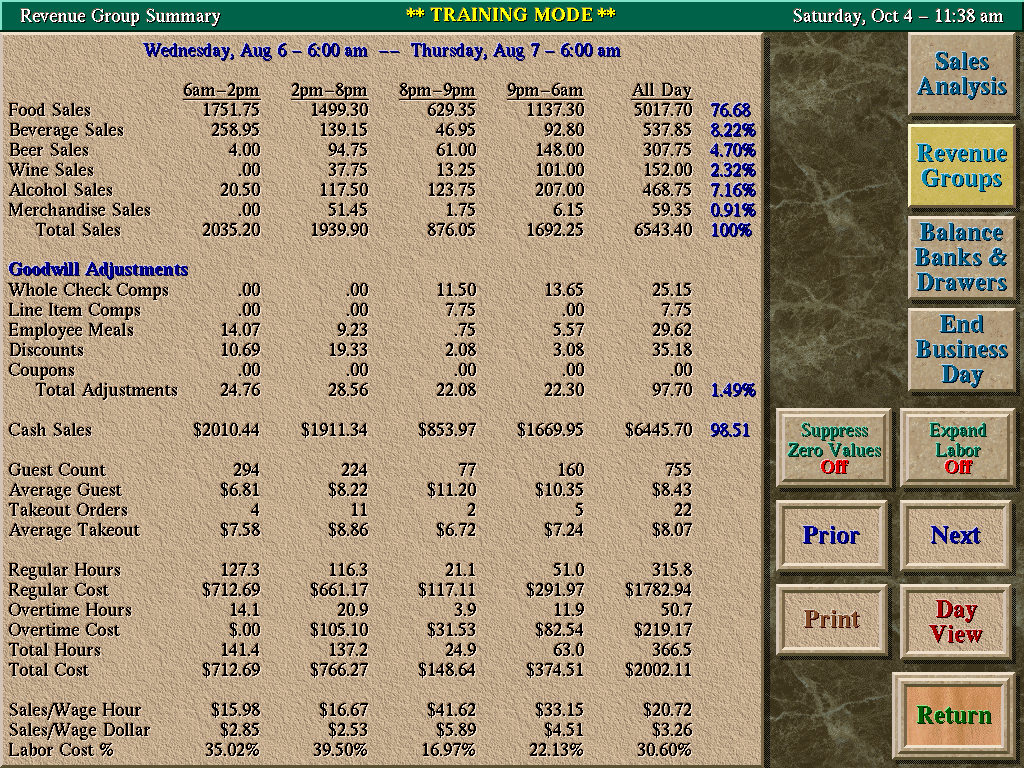
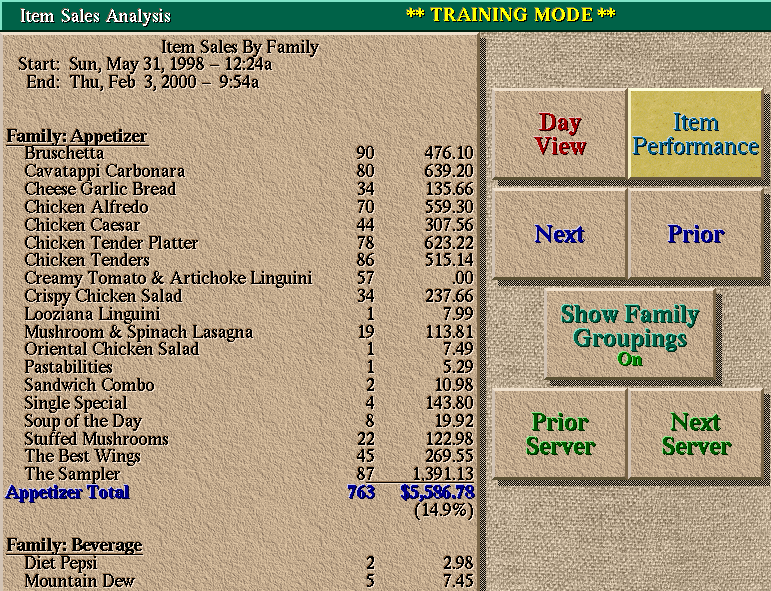
Touch 'n' View Any Day or Any Period Updated Every Minute Every restaurant needs these numbers. You can either train, trust and pay someone to do them, hoping that the numbers are right, or you can rely on ViewTouch for the numbers you need with perfect accuracy and lightning speed. No one will ever be able to find fault with record keeping like this; auditors can see compliance across every period. Finally, you can control NON CASH revenue adjustments and labor costs, including nonintuitive details. The only way you can run a business is `by the numbers' and here are the numbers you need, on each shift! ![]() |
|
We
designed a POS solution to record sales and to provide meaningful
reports
Touch 'n' View A Scalable Framework and an Interface to Store and Query Transactions in a Hospitality Enterprise ![]() Caution: Optional Reading Ahead The
main benefit to you of ViewTouch flat files instead of a database for
storing and indexing data is that it increases "Data Availability" and
decreases "Cycle-Time", for maximum success. There's no need for
monthly data warehouse refreshing. This greatly increases data
"freshness" and your ability to make timely decisions. ViewTouch
directly accesses the file system without having to build the indexes
on the database. This
approach is simplest, and minimizes build and refresh times.
Flat files already existTypically, data feeding into a data warehouse or database is extracted from some other system in the form of flat files, often from a mainframe. If you don't have to load the information into a database to ensure referential integrity of for some other reason, it is possible to index it directly. ViewTouch has an integral database search engine. Data cannot be deleted from flat files but can be flagged as deleted, which serves the equivalent function. Less build time and disk spaceIt takes less time to build indexes from flat files than databases, because you don't need to load the data from some other source into a database. ViewTouch reads flat files directly, without incurring the overhead of the database management system itself. This decreases the "Cycle Time" of loading data and building or re-building the indexes, and increases the "Data Availability" because the data is more available for retrievals. In addition, it takes less disk space to index flat files because ViewTouch stores location pointers instead of row id's with the indexed values. Quick and easy to manipulateData in flat files is very easy to manipulate for prototyping and changing content, or in case a data type needs to be altered or the size of a field/column changed. This is very useful for "exploration" data warehouses, where recursive "design on the fly" and "very ad hoc" query processing are essential. No temp space issuesWhen indexing flat files, you need not worry about running out of temp space, as you do with databases. And you still gain the advantage of parallel processing because ViewTouch can build indexes concurrently across multiple servers even with flat files. No special DBA effortsWhen using flat files instead of a database, no special Database Administration knowledge is required in order to create and load the database. No DBMS license requiredWhen using flat files instead of a database, no licensing fee must be paid. SummaryFlat files are a simpler, easier, faster way to store and access data, if you don't require an actual DBMS for reasons other than data access. ViewTouch does NOT store transaction data in a relational database management system (RDBMS) based on the relational model. Relational databases grow with every transaction until they become VERY large. The larger they become, the more hardware it takes to deal with them. As they grow they slow down virtually every aspect of your PC's operation. Relational databases are not easily consolidated. If another POS company stores your data in a relational database because the programmers don't know how else they might store your data, then it may well be that the people who implemented the relational database on that POS system don't really know much about storing data, and it is likely that that business's ability to actually derive any value from the data is severely obstructed (and here's why). We store your transaction data in a format we designed to make it quick & easy for you to learn WHAT you want about your transactions instead of burdening you with having to know HOW to query a database. There is NO need for ViewTouch users to get get lost in the complexities of Sequential Query Language (SQL) server software or hardware, or to learn how to use SQL to try to make use of the vast body of your organization's transactional data and to manage your operation. ViewTouch transaction data is NOT handled by, managed with or queried by any third-party database software. This data, YOUR data, is TOTALLY secure in this regard. The advantages of avoiding third party software in a POS system may not be obvious, so we'll mention this significant, but typical, example of what invariably can and does happen when your POS vendor relies on third party software. A computer worm named the Microsoft SQL slammer worm security vulnerability invaded systems which depended upon Microsoft's SQL server. On January 24, 2003, this worm caused a large Internet slowdown, the largest malfunction in Internet functionality since the infamous Morris worm of November 2, 1988. We created ViewTouch using third generation programming languages but we also created a state of the art, natural-language, fourth generation graphical query language which is built right into the graphical touchscreen interface. We call it Touch 'n' View and you can see it in each of the reports shown above. It's sophisticated & powerful, but it's also intuitive & easy to use. With it, you have the access you need to all of your transaction data. Touch 'n' View makes SQL obsolete, really, and provides you with a much more modern, simpler, intuitive way to create consistently meaningful reports from the transaction records that your business generates. |